


 +86 18130251359
 teflowpumps@tlpumps.com

Centrifugal pumps serve as core general fluid-handling equipment in chemical production systems, widely deployed across raw material transfer, process circulation, waste liquid treatment, cooling water supply and other full-process duties. Most chemical media are corrosive, high-temperature, viscous or laden with particulate impurities; continuous operation and stable performance are mandatory. Proper pump selection directly determines production line efficiency, maintenance costs and operational safety.
Chemical centrifugal pumps fall into two major categories by mounting configuration: horizontal centrifugal pumps and vertical centrifugal pumps. They share the same fundamental operating principle yet differ markedly in structural layout, space footprint, operational performance and maintainability, making them suitable for distinctly different chemical process conditions. Many plants confuse the two types during equipment procurement, resulting in over-specification or mismatched selection, which triggers excessive energy consumption, higher failure rates and frequent shutdowns. This article analyzes their practical application differences based on real chemical production scenarios to deliver professional guidance for pump selection.
I. Fundamental Structural Differences: Root of Duty Compatibility
The essential distinction between horizontal and vertical centrifugal pumps lies in pump-body and motor arrangement plus shaft orientation — the origin of all application differences, governing space demand, mechanical loading and piping compatibility.
1. Horizontal Centrifugal Pump: Horizontal Layout, Heavy-Duty Robust Construction
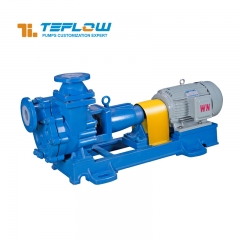
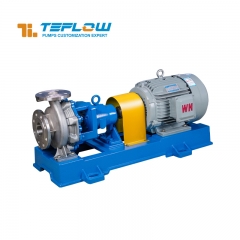
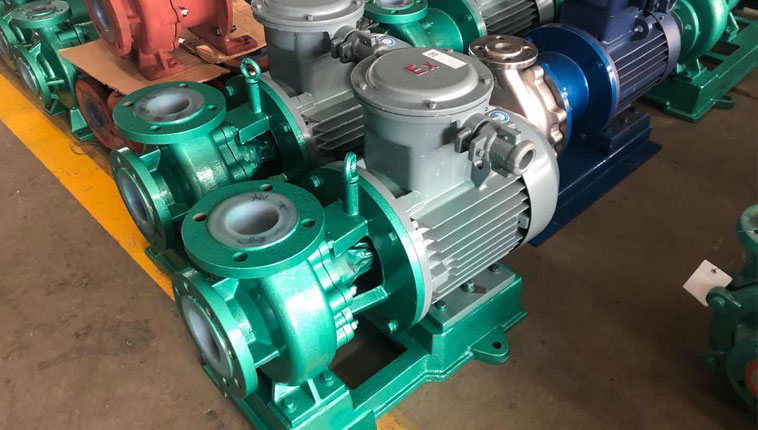
A horizontal centrifugal pump adopts a horizontal coaxial layout, with pump casing, motor and drive shaft installed in a straight horizontal line and fixed to a base. It features a low center of gravity and high structural rigidity. Suction and discharge nozzles form a 90° offset: suction is horizontal along the shaft axis while discharge points radially upward. Piping can run flat along the floor without frequent vertical offsets.
This configuration evenly distributes loads across mechanical seals and bearings; axial thrust is released horizontally. The pump runs smoothly with low vibration and strong shock resistance, capable of sustained 24-hour heavy-duty service in chemical plants. All key components are exposed and accessible, greatly simplifying inspection and maintenance.
2. Vertical Centrifugal Pump: Vertical Layout, Compact Space-Saving Design
A vertical centrifugal pump features a vertical coaxial arrangement with the motor mounted above the pump casing. The pump shaft stands perpendicular to the floor, eliminating a heavy base and minimizing floor space. Suction and discharge nozzles are collinear and co-directional, allowing direct inline installation like a valve for tidy piping layouts.
Its primary merit is ultra-small footprint, ideal for confined spaces such as pipe trenches, equipment mezzanines and underground pump rooms. Bearings and seals sit above the liquid level, avoiding immersion in humid or corrosive media and extending service life of wear parts. The tradeoff is greater overall height, which imposes constraints on available headroom.
II. Core Application Differences in Chemical Processes: Matching Pump to Duty
Chemical duties range from high-flow heavy-duty transfer and confined-space circulation to corrosive media handling and high-temperature/high-pressure processes. Structural characteristics define each pump’s optimal scope, the core criterion for chemical pump selection.
1. Horizontal Centrifugal Pump: Preferred for Demanding Heavy-Duty Chemical Duties
Superior stability, large flow capacity, high head and easy maintenance make horizontal pumps the mainstream choice for large chemical production lines and continuous heavy-duty processes where reliability and service access are priorities.
Bulk raw material and finished-product transfer: Horizontal pumps are widely used in petrochemical, coal chemical and fine chemical facilities for crude oil, refined products, methanol, ethanol and industrial solvents. These duties involve high flow rates and extended runtime; modest particulate contamination is common. Their robust construction resists vibration drift and component wear to sustain uninterrupted production.
High-temperature and high-viscosity media: For thermal oil, viscous resins and slurries, the horizontal layout prevents gravitational sedimentation. Mechanical seals experience balanced loading for consistent sealing performance, mitigating leakage and seal failure in high-temperature, high-pressure process piping.
Plant utility large circulation systems: Cooling water networks, centralized process wastewater transport and firewater supply commonly use horizontal pumps. Such systems span long distances and undergo frequent load swings; horizontal units withstand load shocks and offer ample access for routine inspection, component replacement and troubleshooting.
Severe corrosive and solids-laden duties: When handling sulfur-containing wastewater, acid/alkaline effluent and particle-bearing chemical slurries, horizontal pumps can be fitted with 316L stainless steel or fluoroplastic wetted parts. Their large casing delivers good through-flow and anti-clog performance. Impellers and seals can be quickly removed for replacement, minimizing production downtime.
2. Vertical Centrifugal Pump: Optimized for Compact Layout and Light Circulation Duties
Vertical pumps excel at minimal footprint, flexible installation, low noise and reduced maintenance frequency. They target lightweight, compact chemical duties suited to space constraints and clean, steady circulation; they are not designed for continuous high-flow heavy-duty operation.
Confined-space equipment integration: Pipe trenches, mezzanines, lab-scale units and reactor auxiliary circulation systems are prime vertical-pump applications. Vertical inline mounting occupies negligible floor area and fits tightly within process equipment layouts.
Clean media boosting and circulation: Vertical centrifugal pumps are preferred for ultra-pure water, process soft water, cooling clean water and low-corrosion clean solvent circuits requiring pressure boosting, stabilization and circulation. They operate quietly with low vibration. Bearings and seals remain above the liquid, minimizing chemical attack and extending service life by 2–3 times under clean conditions with excellent long-term stability.
Wastewater lift and shallow intake: Vertical submerged pumps and vertical inline pumps suit underground sump lifting, shallow process water intake and cooling tower circulation. The vertical wet end can extend directly into the liquid for easy installation and reliable containment, reducing elbow fittings and simplifying system design.
Small-scale chemical plant auxiliary systems: Fine chemical, pharmaceutical and daily-chemical small-batch production often employs vertical pumps for process water circulation, low-temperature cooling circuits and minor booster supply. These duties feature stable, moderate loads; vertical pumps offer favorable cost, simple commissioning and lower ongoing maintenance burden.
III. Performance & Maintenance Comparison: Key Selection Metrics
Beyond application scope, tradeoffs in energy consumption, service difficulty, failure risk and capital expenditure heavily influence chemical plant procurement decisions and total lifecycle cost.
1. Piping Energy Loss and Operational Stability
Horizontal pumps have offset nozzles, allowing flat piping with fewer elbows and lower localized resistance, reducing system head loss. Under equal process conditions, they deliver better energy efficiency and fit long-distance high-flow transport. Vertical inline pumps require pipe routing changes, introducing extra local losses; they consume slightly more power in sustained high-flow service and are better suited to short-loop, low-flow circulation. Horizontal units also benefit from a low center of gravity and stronger vibration resistance, maintaining stability during load fluctuations; vertical pumps with elevated centerlines may exhibit minor vibration under extreme flow conditions.
2. Maintenance Accessibility
All critical components on horizontal pumps are exposed. Impellers, mechanical seals and bearings can be serviced without dismantling process piping, enabling single-person maintenance and shorter downtime — a major advantage for continuous chemical production and minimizing lost output. Vertical pumps, especially inline and submerged variants, often require removal of the upper motor and piping for servicing. Procedures are lengthier and more complex; deep wet-end maintenance on vertical submerged pumps is particularly challenging, making them a better fit for low-fault, steady light-duty circuits.
3. Failure Rate and Service Life
Horizontal pumps feature mechanically balanced horizontal seal loading without vertical gravitational compression, so seal wear is uniform and leakage risk is lower. They demonstrate lower failure rates and longer service life under heavy-duty, solids-laden and high-temperature chemical environments. Vertical pumps keep bearings and seals above the liquid, yielding minimal wear and extended maintenance intervals in clean media. However, in particle-rich or highly corrosive services, sediment accumulation and misaligned component loading can sharply raise failure risk.
4. Initial Installation Cost
Horizontal pumps need dedicated concrete foundations and larger pump-room footprints, increasing upfront civil and installation investment. Vertical pumps require less complex basework, occupy minimal space and cut civil costs. Lower initial outlay makes them economical for space-limited, budget-constrained small chemical projects.
IV. Selection Summary
Choose horizontal centrifugal pumps for: high-flow, high-head, long-distance media transfer; high-temperature, viscous, solids-laden or strongly corrosive severe duties; 24-hour continuous heavy production; and core process lines with ample floor space and frequent maintenance demand.
Choose vertical centrifugal pumps for: confined areas including pipe trenches and mezzanines; clean-media pressure stabilization and small booster supply; shallow intake, sump lifting and cooling tower circulation; and low-load, steady auxiliary circuits prioritizing low maintenance cost.
No pump type is universally superior; the right choice depends on matching equipment to operating conditions. Horizontal centrifugal pumps deliver robust heavy-duty performance, easy service and tolerance for harsh chemistry, forming the backbone of core production lines. Vertical centrifugal pumps offer compactness, low noise and cost advantages, making them optimal for auxiliary circuits and space-constrained installations. Matching pump configuration precisely to process requirements safeguards stable production, reduces energy use and optimizes total lifecycle maintenance expenditure — a vital element of refined equipment management at chemical facilities.



 +86+0563-5093318
