


 +86 18130251359
 teflowpumps@tlpumps.com


Alkali production is a core pillar of the basic chemical industry, encompassing three mainstream production systems: soda ash (Solvay process / combined soda process), ion-exchange membrane caustic soda, and sodium bicarbonate. The entire production flow — from brine purification, causticization reaction, ammonia distillation and carbonization crystallization to caustic liquor circulation, mother liquor transfer, salt sludge treatment and end-of-line alkaline wastewater treatment — operates long-term in highly alkaline, high-salt environments. The process media include concentrated caustic soda solution, sodium carbonate/sodium bicarbonate solutions, saturated brine, ammoniacal brine and salt sludge slurry, which generally feature strong alkalinity, high salt content, easy crystallization precipitation and entrained solid particles.
The core criteria for pump selection in the alkali industry are: resistance to strong alkali corrosion, tolerance to high-salt environments, anti-crystallization and anti-clogging performance, wear and particle resistance, and leak-free operation, to ensure long-term continuous and stable operation of alkali production units.
I. Working Conditions and Medium Pain Points in Each Alkali Production Process
1. Brine Purification Process
Crude saturated brine carries solid impurities such as calcium-magnesium sludge and salt particles. In a high-salt environment, chloride ions coexist with alkalinity, causing corrosion combined with particle erosion. In raw salt dissolution and brine clarification & filtration stages, salt crystals readily precipitate from the medium and tend to deposit and scale inside the pump cavity and on the impeller, resulting in narrowed flow passages and reduced efficiency.
2. Causticization, Ammonia Distillation and Carbonization Processes
- Causticization section: Lime milk reacts with soda ash to produce caustic soda solution. The medium contains calcium carbonate particles, with strong alkalinity and high solid content, presenting both wear and corrosion challenges.
- Ammonia distillation section: Ammoniacal brine and mother liquor operate at relatively high temperatures with ammonia gas release, bringing high cavitation risk. Reliable sealing is required to eliminate ammonia leakage.
- Carbonization section: Sodium bicarbonate crystal slurry has high solid particle content and is prone to scaling. Pumps require wide flow passages and wear-resistant wetted surfaces to reduce crystal adhesion and clogging.
3. Caustic Liquor Circulation and Mother Liquor Transfer
Clear-liquid media such as ion-exchange membrane caustic soda electrolyte, finished caustic liquor and soda ash mother liquor are highly corrosive with stable compositions. They impose strict requirements on pump sealing performance and continuous operation capability; leakage is strictly prohibited to avoid material loss and safety hazards.
4. Salt Sludge Transfer and Alkaline Wastewater Treatment
Salt sludge slurry contains a large volume of solid sediment with strong abrasiveness. End-of-line alkaline wastewater has fluctuating compositions, alternating acid-alkaline conditions and high salt content, requiring both corrosion and wear resistance while meeting environmental zero-leakage requirements.
II. Main Recommended Pump Type: Fluoroplastic Magnetic Drive Pump
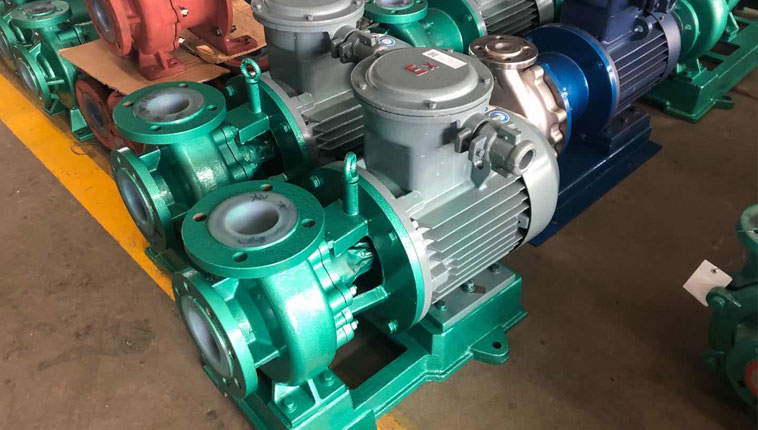
Targeting the core demands of high alkali resistance, high salt tolerance and leakage prevention in the alkali industry, fluoroplastic magnetic drive pumps are the optimal solution for clear alkaline liquid delivery. Featuring a magnetic coupling shaft-seal-free structure, they completely eliminate traditional mechanical seals and avoid failures caused by sealing surface wear or spring corrosion. They achieve zero external leakage of strong alkaline media, fundamentally eliminating running, emitting, dripping and leaking issues as well as potential safety hazards.
Material Selection and Adaptable Scenarios
- PVDF material: Suitable for most clear-liquid alkali production conditions from room temperature to 80℃, including caustic soda solution, sodium carbonate solution, saturated brine and ammoniacal brine. It offers strong alkali resistance, chloride ion corrosion resistance, high mechanical strength and good particle erosion resistance, and is the mainstream material choice for brine purification, caustic liquor circulation and mother liquor transfer.
- FEP/PFA fluorine-lined structure: For high-temperature concentrated alkali and high-purity liquid caustic soda delivery scenarios, it has stronger chemical inertness, a higher temperature resistance limit and excellent permeation resistance. It withstands long-term corrosion from medium-to-high temperature concentrated caustic soda with extremely low ion precipitation, and is suitable for the refining process of ion-exchange membrane caustic soda.
- Optimized flow passage design: The pump cavity and impeller are integrally fluoroplastic-lined with a smooth inner wall, making it difficult for salt crystals and alkali scale to adhere and deposit. Wide-passage impellers are optional to improve the passability of fine salt particles and trace crystals, reducing clogging risk.
III. Supplementary Adaptable Pump Types (For Specific Working Conditions)
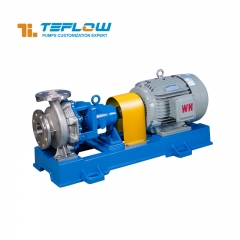
1. Fluorine-Lined Centrifugal Pump
All wetted components are fully lined with fluoroplastics, delivering alkali and salt corrosion resistance equivalent to magnetic drive pumps, and adopt a mechanical seal structure. Its advantage is high cost-effectiveness for large-flow conditions. It is recommended for branch-line applications such as large-flow brine transfer and wastewater treatment, where cleanliness requirements are moderate and regular seal maintenance is acceptable. It is not recommended for main-process delivery of high-risk media such as high-concentration finished alkali and easily vaporizable ammoniacal brine. When in use, it must be fitted with dedicated alkali-resistant mechanical seals, and seal wear shall be inspected regularly.
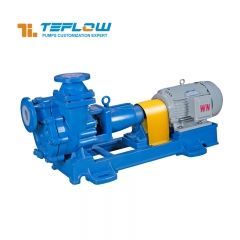
2. Fluorine-Lined Mortar Pump (Special for Salt Sludge / Carbonization Slurry)
Designed for high-solid-content conditions such as salt sludge and sodium bicarbonate crystal slurry, it adopts a wear-resistant fluoroplastic lining and a wide-passage open impeller structure, purpose-built for conveying alkaline slurry containing solid particles. It delivers excellent anti-clogging and erosion resistance, solving the common pain points of rapid wear and frequent clogging faced by ordinary magnetic drive pumps and centrifugal pumps in high-solid-content applications.
IV. Key Points for Alkali Pump Selection
1. Select materials precisely by temperature and concentration: PVDF is suitable for room-temperature dilute alkali and brine; FEP/PFA lining is preferred for high-temperature concentrated alkali. Avoid material downgrading that may lead to premature corrosion failure.
2. Prioritize anti-crystallization and anti-clogging performance: For crystallization-prone and salt-particle-laden conditions, prioritize wide-passage and open impeller structures. Install filters at the pump inlet to intercept large salt lumps and debris, and flush the pump cavity with clean water or dilute solution promptly after shutdown to prevent salt crystals from seizing the impeller.
3. Match sealing safety level: For high-risk, volatile media such as finished alkali and ammoniacal brine, shaft-seal-free magnetic drive pumps are mandatory. For wastewater and low-risk branch lines, fluorine-lined centrifugal pumps may be used with dedicated alkali-resistant seals.
4. Verify net positive suction head (NPSH): For ammonia distillation and negative-pressure flash discharge conditions, fully calculate the NPSH margin, and select low-NPSHr pump types or supporting pre-diversion structures to prevent cavitation impact from damaging the fluorine lining.
5. Adapt to continuous operation: Most alkali production units run continuously year-round. Select bearing and magnetic component configurations rated for long-period operation to reduce shutdown maintenance frequency.
V. Summary
The core operational challenges in the alkali industry lie in high alkali corrosion, high-salt abrasion and crystallization clogging, coupled with stringent leakage control requirements. Fluoroplastic magnetic drive pumps, with their comprehensive strengths of full-fluoroplastic alkali and salt resistance, seal-free zero leakage and smooth anti-scaling inner walls, cover the main clear-liquid processes including brine purification, caustic liquor circulation, mother liquor transfer and ammonia distillation. For high-solid-content salt sludge and carbonization slurry, fluorine-lined mortar pumps are the appropriate choice; for scenarios such as large-flow branch-line wastewater, fluorine-lined centrifugal pumps can be deployed as a supporting solution.
Rational selection centered on the three core principles of "corrosion resistance, clogging resistance and zero leakage" not only ensures long-term stable operation of alkali production units, but also reduces operation and maintenance costs as well as safety and environmental risks, making it a reliable fluid conveying solution for the alkali manufacturing industry.



 +86+0563-5093318

